


Pflege des Kindes
Bathing
- Bathing once or twice a week is sufficient, otherwise wash daily with a washcloth.
- Room temperature 24 °C
- Bath water temperature 37 °C
- Have a bath towel, fresh linen and care products ready to hand.
- Bath additive is not necessary for healthy babies - skin lubricates itself
- Use the bath handle to hold the baby securely (head resting on the wrist, fingers clutching the baby's upper arm)
- Start by washing the eyes from the outside in, then the face, hands and arms and armpits, upper body, torso, then the legs and finally the genital and buttocks area.
- When drying, pay particular attention to skin folds and the spaces between fingers and toes (risk of sores)
- It is not necessary to apply cream or powder to healthy baby skin, keep the navel dry and clean.
- The foreskin of boys must not be pushed back as it is naturally constricted (so-called phimosis).
- Changing and dressing the child
- Only clean the outside of the ears and behind the pinna
- Never clean the nose and ears with cotton buds (risk of injury)
- Brushing the hair
- Only cut nails after two months, otherwise there is a risk of nail suppuration
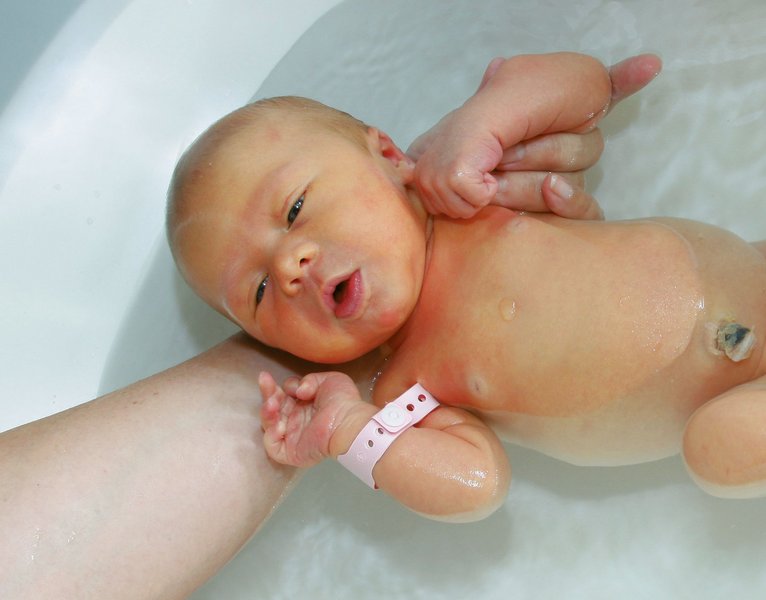
Baby healing bath
If your baby is behaving abnormally (crying frequently, is difficult to calm, has to be carried a lot, sleeps badly, etc.), this ritual can be used to restore basic trust.
Ask your aftercare midwife about this.
- Create an atmosphere that is as pleasant and protected as possible (room temperature, subdued lighting, etc.).
- Lie down in bed with your bare upper body and cover yourself with a large, cozy bath towel.
- The baby is bathed by the person helping you, then placed wet and naked directly on your upper body and you are both covered with the pre-warmed bath towel.
- Re-bonding and the start of the healing process for body and soul can begin.
- Later, you can repeat the healing bath alone with your child two to four times (or more). You bathe your child and place it directly on your chest. Cover yourself and your baby, cuddle together and if your baby signals to you that it wants to be breastfed, then enjoy breastfeeding.
- It is normal for mother and child to cry a lot.
Sleeping the child
- Smoke-free environment
- Room temperature: 18-20 °C
- Hard mattress
- No pillows, no stuffed animals
- Do not use animal skins as carpet pad (allergy and overheating)
- Avoid prone position (risk of sudden infant death syndrome)
- Child in supine position
- Child in sleeping bag, without blanket
Taking the baby for a walk
If possible, go for a walk immediately after coming home - fresh air strengthens the immune system of mother and child. The child should be dressed and protected depending on the weather. Protect the baby's face from the cold, but also from the heat (hood). To avoid putting too much strain on the pelvic floor, the mother should only take short walks.
Skin changes
- Milia: white spots on the nose, chin or forehead - disappear by themselves by the 3rd month of life.
- Newborn rash: red spots or pustules that can appear all over the body for a few weeks of life. Treatment is not necessary.
- Baby acne: a rash on the baby's face that can reappear after around three to six weeks due to the mother's hormonal changes. Treatment is not necessary.
- Diaper dermatitis: reddened or weeping areas in the diaper area, think about intolerance to disposable diapers or wet wipes, allow plenty of air to reach the skin, do not use powder. It is best to clean the diaper area with a washcloth only.
- If there is severe redness on the buttocks, please contact your doctor or postnatal midwife.
- Dry, scaly skin all over the body (e.g. if the due date has passed) can be treated with jojoba, almond or olive oil.
Oral thrush (fungal infection)
- White, firmly adhering coating on the oral mucosa which must be treated by a doctor.
- In breastfed children, the mother's breast must also be treated.
Mammary gland swelling in newborns
Is caused by the mother's hormones. Treatment is not necessary. Do not press on the baby's breast! If there is redness, a medical assessment is necessary.
Difficult nasal breathing in newborns
If the child sniffs or secretions come out of the nose, clean the nose. The following can help with breathing: elevate the baby, humidify the air in the room, drip breast milk or physiological saline solution (available from chemists) into the nose.
Recommendations for the prevention of "Sudden Infant Death Syndrome" (SIDS)
What is SIDS?
SIDS is the abbreviation for "Sudden Infant Death Syndrome" and is one of the most common causes of death in infants.
How does "Sudden Infant Death Syndrome" occur?
SIDS mainly occurs during sleep and mainly affects babies in the first year of life, in the prone position.
" Parents are not at fault! "
To what extent has SIDS been researched so far?
Despite intensive research worldwide, the causes of "sudden infant death syndrome" are not yet known. SIDS cannot be prevented with certainty. However, some risk factors appear to exist.
What can parents do?
- Breastfeeding
- Lie the child on its back while sleeping
- cool room temperature between 18 and 20 °C in the bedroom
- Regular mother-child check-ups
- temperature-appropriate clothing and sleeping bag, do not overheat
- Frequent physical contact
- Harmonious environment and balance
Avoid the following:
- Cigarette smoke in the home/child's room
- Smoking by parents
- Prone position during sleep
- Overheating and hypothermia
- Head cushions and mattresses that are too soft
- Stuffed animals in the crib
If there is a risk, home monitoring can be carried out.
You can obtain further information from your pediatrician.